How I'm Learning Trad Climbing
I’ve been learning to trad climb for nearly as long as I’ve been climbing. I’m still learning about trad, gaining experience in trad, and refining my practices. I will be forever.
I didn’t start climbing with trad climbing. I started with bouldering and then pretty quickly got into leading sport climbing.
Below is my joyous climbing learning journey with many many lessons from helpful mentors and numerous don’t-do-it-this-way mistakes including a few minor-to-moderate injuries.
Bouldering, March 2014
My friend, K, invited me to go to the North Austin Rock Gym (NARG). I loved it! I also invited that friend to do parkour classes near NARG, and we enjoyed those. Bouldering indoors is a pretty low commitment way to enter climbing. You don’t need to learn the rope system for safety. You can focus on learning movement and gaining strength - which is what I gained from my early days in bouldering. I also made a bunch of friends and started to learn the community side of rock climbing. We always went to the gym with a group of people, and generally went out for drinks and food afterwards. We would learn climbing tips from each other, and have a fun time together. While bouldering is not trad, the basic elements are certainly overlapping. And they can be the gateway for many people to the more dangerous styles of climbing.
My friend, K, found bouldering at Bull Creek, and took me and some others out there. Getting on some of the boulders, not even on a climbing route, just scrambling around was so satisfying.
Getting outside, April 2014
My first experience climbing outside with a rope was on top rope at Enchanted Rock. That same friend wanted to join me hiking at Enchanted Rock so he could also show me climbing outside. So we hiked with some of my Paleo friends. I remember using a small camping stove to heat water to make couscous and eating it atop the main dome - it was an incredible experience and a big influence to the type of camping stove I have and use today.
After the delicious meal, we hiked down into Echo Canyon so my friend could setup some top ropes at Motorboat and we could both top rope them. I had never climbed on a rope, or belayed. So, I knew nothing as we got to the base of the climb. My partner showed me the basics of taking in slack and ensuring I had a hand on the brake strand the entire time when using a tube-style belay device (not assisted braking). It all seemed easy enough. My partner got to the top of the climb and yelled something at me. I didn’t know what they said. They yelled it again - “Take!” I must have responded with something like “What do you mean?” They had to explain “Take” at the top of the route during my first belay. They meant for me to take all of the slack out of the rope, making them as tight as possible at the top - a common command before someone is lowered after finishing a climb. Gotcha. When they got to the ground, I asked them to explain more to me next time I’m doing something new haha.
Ok, so then I top roped the same route. And we did another route that day. They were both really tough for me. They were 5.7 and 5.6, respectively.
We camped at Enchanted Rock that night. And, when we got to our campsite, I couldn’t find my tent in my trunk among all of the other stuff in my trunk. Fortunately, I saw my tarp. So, I made a make-shift tent from the tarp and slept on the ground. Ironically, it was my friends tent which was broken into by a raccoon which stole a pack of food out of the tent. We tried to catch the animal, but it got away. A lesson in keeping food away from animals when camping.
The next day, we headed over to Reimer’s Ranch to do some sport climbing. I knew nothing about this kind of climbing either, for it was only my second day climbing on ropes. But my friends were there, and they’d help me learn. We went to Dead Cats Wall and they prepared me to lead the 5.5 by teaching me about quickdraws and backclipping. It went well. And, I top roped a few 5.10s that day. It was so amazing climbing outside.
I adored the experiences at Enchanted Rock and Reimer’s Ranch. In nature. Routes less obvious than the gym. The adventure of the problem solving. Risk. The rope system.
The same friend brought me to Seismic Wall where I started to really gain sport leading experience. I found myself going to Seismic after work, before work, with people who’d never climbed and teaching them what they needed to know at the wall. I had many great times out there.
Curiosity and inspiration, Yosemite, September 2014
In that first year that I started climbing, I took a trip to Yosemite with some friends to camp and hike. They weren’t getting into climbing like I was. Like many tourists in Yosemite, I was in awe of the mountains, the scale, the power of the moving water.

But also, I was curious about the climbers I saw on the walls in the Valley and in Tuolumne. How did they go up so high? I’d only been up single pitch routes in Texas. How the hell did they get back down? I briefly talked about this in my Joshua Tree Trip Report but I’ll revisit here given the context of this post.
Starting to learn from books, December 2014
After Yosemite, I bought many books on climbing:
- Trad Climbers Bible - a collection of stories from John Long and Peter Croft about their adventures trad climbing
- How to Climb: Big Wall - the systems for climbing up mountains like El Capitan or Half Dome
- How to climb - top roping, sport leading, trad leading, anchors, rappelling
- Climbing Anchors - how to make SERENE anchors
- Yosemite climbing guides
- Self-rescue
I read them all. I definitely don’t remember everything! But they broadened my awareness of the adventurous possibilities and the many climbing safety systems.
Reading Accidents from American Alpine Club, January 2015
I became a member at the American Alpine Club and started reading the Accidents in North American Climbing. These of course gave me insights into what to avoid, but they also taught me what to do and prioritize - having a plan, communication, having a way to communicate with emergency responders in the backcountry, etc.
Buying my first trad gear, March 2015

In March 2015, I bought a basic trad rack - nuts, hexes, a single set of cams, a Petzl Reverso. I didn’t have a plan to use it. I hadn’t followed any trad leader. I didn’t have a trad mentor.
But all of the books and gear were only part of learning; I hadn’t actually put any of the things I’d read or bought to use! But those days would come soon enough :)
My first multipitch, April 2015
On a work trip to Japan, my friend, K, took me outsite of Tokyo to climb a multipitch route (Futagoyama Central Ridge, 6 pitches, 5.8). It’s an old alpine route which has old stuck pitons and some newer bolts in the pitches, and bolts at the anchors (at least the first few).
My friend K taught me how to make a basic anchor at the bolts using quick draws and clove hitches and to use my tube style device to belay him up. Awesome experience. While the pitches also had old pitons and newer bolts, there were also plenty of opportunities to place our own cams.

On one of the pitches I led, I got a little off route - I couldn’t find the bolted anchor! So, running out of gear, and at a comfortably large terrace which had some old tat, I opted to make a gear anchor.
My “anchor” when I got a little off route in Japan
This was my first time trying to make a gear anchor. On lead, a few hundred feet off the ground. I was already nervous because I was off route. But was a little more nervous trying to build a gear anchor for the first time. Fortunately, I had read some books so had some idea of basic principles like connecting pieces together with a sling and slinging natural protection with girth hitches. And also fortunately, I had some trad gear with me! We never weighted the anchor.
But, we were able to continue up to finish another pitch. And then we rappelled.
Rappelling was scary for me. Like usual with K, I was safe, but learning while doing. He taught me to rappel as we were doing it. We used a Figure 8 device. For me, I had too many wraps around the Figure 8 and the rappel was very slow, and I needed to pull a lot to make downward progress. My shoulders got tired.
K added some sling to the last rappel to backup the existing tat. And we made it safely to the ground.
I’d learn a lot more about leading trad, anchor building, and rappelling later.
But one thing I learned for sure: Multipitch was awesome.
My first top rope anchor, Clear Creek Canyon Boulder, CO, September 2015
Later that year, I was on a trip with friends from the Paleo community in Boulder, CO. One of my friends, MJ, was getting into climbing back home, so I wanted to take him and his friend out to do some sport climbing.
But, the climbs near us weren’t equipped with the type of sport anchors I was used to in Austin. In Clear Creek Canyon, we’d need to provide our own top rope anchor into the bolts at the top of the pitch.
Leveraging what I read in books, I bought some short nylon slings and lockers, and made a simple anchor with two overhand knots to limit extension, and placed two lockers opposite and opposed inside a sliding X in between the extension limiting knots. The leader would use two lockers to connect the anchor, and the two lockers in the X to connect the rope we’d top rope from.
We’d also need to clean the anchor, and lower. I can’t remember what we did but we probably anchored in, untied and threaded the climbing rope through the rings on the bolts, retied, and lowered. There’s a safer way to clean a top rope anchor that I learned later - https://www.vdiffclimbing.com/clean-bolted-anchor/

My first trad lead without bolts on the pitch, Enchanted Rock, October 2015
From my Joshua Tree Trip Report:
My first ever trad lead was at Enchanted Rock’s Jack Knife (5.5, 1 pitch). I was out there with Scott, Karthik, and Caroline. I sure remember feeling confident enough to lead the route - I’d led a lot harder sport routes. I remember gearing up not knowing exactly which gear to bring. I remember bringing hexes up the route and them rattling as I climbed past their poor placements. I had NOT learned trad gear placement yet. I had not practiced trad gear placement. I finished the route and got down without ever weighting my trad placements.
I don’t recommend learning gear placements this way, and I’ll elaborate on my recommendations later.

Sandstone has awesome friction, Red Rock, November 2015
During my first trip to Red Rock in Nov 2015, I learned a few different things:
- The Red Rock sandstone has substantially more friction than slimy polished limestone I was used to from Seismic Wall in Austin.
- Multipitch is awesome and prefer it over bouldering.
- Watching and singing along to Britney Spears during her residency at the MGM was also awesome, and so worth it.
We climbed boulders in Calico and sport routes in Calico, including a multi-pitch sport route with a walkoff named Big Bad Wolf.

Ow! My first crack jamming follow, Enchanted Rock, November 2016
Before my next trip to Red Rock, I wanted to practice at Enchanted Rock. So I followed M and others out to the Triple Crack area in Echo Canyon.

I was very quickly humbled. Crack climbing was so hard! My feet hurt in my La Sportiva Solutions (aggressive shoes), so I bought La Sportiva Mythos the next week. And even though we used tape to make gloves for our hands, crack climbing hurt my wrists and arms.
My belay mistake and I didn’t want to speak up, Red Rock, November 2016
In my second Red Rock trip, M led the first two pitches of Big Bad Wolf, and I led the last pitch. I remember feeling off about my top belay for M. Turns out I didn’t setup the belay right. I can’t remember how I messed it up, but it wasn’t right and I didn’t tell my partner. I’m glad he didn’t fall. M led all of Physical Graffiti since it’s a trad route, and he was going to be placing the gear for us.
Practicing top belaying in a safe way is crucial, since when you do it for real, there’s no one there to check your setup.
We also climbed more boulders in Calico, including Plumber’s Crack. I was scared in Plumber’s Crack - the top is so high! But everyone else seemed OK bouldering so high in the chimney. So, I powered through it.
Eventually I’d mature and talk about my mistakes and concerns :)
New partners, Red Rock, November 2017
I realized the night before the trip that I lost my Mythos at Reimer’s :(
So I’d be starting the trip in my more aggressive (than Mythos) gym climbing shoes, La Sportiva Otaki.
M and I partnered up again, and started on Great Red Book. I wasn’t ready to lead trad yet, so M led all of the pitches. We topped out without mistakes! Though the gym climbing shoes weren’t great - they were probably too worn and slipped in some places.
After we both topped out and came off belay, I was sitting and M was horsing around leaning across a chasm - nothing he could fall to his death down. As my back was to M, I heard a commotion and thought the worst - that he fell down the 3 pitch route. Fortunately, that didn’t happen. Unfortunately, his hand dislodged a football sized block of sandstone. It hit his helmet and one of his hands and gashed his hand open. He was bleeding badly.
We improvised direct pressure for the injury with a sock and climbing tape and that stopped the bleeding. But, we also had 2 friends behind us. Once they got to the top and were safe, we told them about the accident and that we needed to leave as quickly as possible. We hiked an hour and a half back to the car, drove about 30 minutes into Summerlin to an urgent care clinic and M got stitched up. Fortunately, that’s all he needed. Glad he didn’t get more injured.
Since I had lost my Mythos, we stopped at the Desert Rock Climbing store and fortunately they had TC Pros in my size. I’ve resoled this pair twice, and still wear them today!
Sadly, M couldn’t climb anymore. He flew home. I took the next day off, got a massage, saw a movie.
And was able to make plans for the subsequent two days to follow L, a very experienced trad leader. We got to climb Frogland (5.8) and Bourbon Street (5.8) in one day, and Sour Mash (5.10a) in another day. I got more crash course lessons in rappelling from L since we took a descent from Frogland which forced us to rap once. And then Sour Mash was a multipitch trad route also in Black Velvet Canyon that we’d have to rappel.
 (Black) Velvet Canyon, Red Rock
 Sour Mash, Red Rock
And, then I met Luke and H. We’d climb Cookie Monster (5.7) with Luke lead climbing and lead rappelling Cat In The Hat (5.6).
And then I’d climb Crimson Chrysalis with Luke (5.8+). D & S (and maybe also L & H) were with us on Crimson Chrysalis. They went before us. Luke led in our party. We made it up 2 pitches, and let a party behind us pass us. And after that, we saw D & S lowering to us. They’d already finished the route and were almost done rappelling. At that point, Luke and I called it quits, there was no way we were fast enough for the route (yet).
 Crimson Chrysalis, Red Rock
I got a lot of practice following and cleaning trad gear - I felt comfortable and proficient with both of those. I also got quite a bit of rappel practice and very much appreciated having a partner checking my setup.
And my stance on multipitch grew - it was amazing - the best kind of climbing.
A mentor emerges: learning gear placements & anchors, Enchanted Rock, August 2018
But if I was going to lead trad, I’d need to get a lot more experience placing gear, building anchors, and rappelling.
After Luke and I climbed some in Austin at the Austin Bouldering Project, Luke was kind enough to take me out to Enchanted Rock for trad practice.
We practiced gear placement, anchor building, and belaying up the second in Echo Canyon on the nearly horizontal slabs for hours. This was priceless.
We climbed Jack Knife and Cave Crack, with me leading the end of Cave Crack, and using the Connecticut Tree hitch at the top to belay Luke up.
Then we turned Texas Flake (a 1 pitch 5.6 trad route) into a 3-pitch trad route :) to practice multipitch needs: anchor building, top belaying, swapping leads, and rappelling. We repeated the route. I led half of the pitches.
This was great practice. Enough to inspire confidence for me to lead in our upcoming Red Rock trip.
My first trad multipitch leads, Red Rock, November 2018
We’d start our Red Rock climbing the day we landed. So, we wanted to select a short route with a short approach, so we wouldn’t get stuck climbing in the dark. We selected Geronimo (5.6, 4 pitches). We got a little lost finding it - bummer. But made it eventually. There were oodles of parties ahead of us. We waited at the base, and eventually climbed. I led the first pitch. The parties in front of us were slow. Luke led the second pitch. We crossed the terrace to consider going up pitch 3. We found a guided party of 3 coming down. They told us of many climbers ahead, including a slow guided party. Luke taught them about the Connecticut Tree hitch, but I kept substituting other silly names. We decided to bail and the guide of the 3-person team was nice enough to let us rap their lines to speed up our descent. She was super nice, and I’m grateful to her. We made it to the ground right before we needed our headlamps.
We also climbed Jubilant Song, a 2-hour approach, trad gear-only (no bolted anchors), 5.8, 8 pitch route that we’d walk off. D gave us great beat on the descent. Luke led the hard pitches, but some parts of my leads were still tough for me - I remember a committing move above desert varnish on the pitch after the traverse. I was able to employ a CT hitch for one anchor, and made a 3-piece Dyneema linked anchor with an overhand knot for the master point for another, and I don’t remember what I did for others.
 Jubilant Song (5.8, 8 pitches, swung leads with Luke)
Next we’d climb Group Therapy (5.7, 6 pitches), known for a roof where you’d need big gear - so we’d bring a #5 or #6. I led the roof pitch even though I was feeling a little under the weather and a little scared. I didn’t share that with Luke ahead of time. We finished the route without mistake, though it did take me quite a while to make some of the anchors, especially the first. At which point a team of 3 passed us, with the leader climbing barefoot and the 2 followers climbing with so much slack in their rope any fall would be quite far.
 Angel Food Wall with Group Therapy (5.7, 6 pitches)
Finally, we finished on Johnny Vegas which gobbled up nuts in the first few pitches and I got 2 of our nuts (Luke’s) so stuck they were irretrievable. And to make it more interesting, I also dropped half of our nuts (Luke’s) on an upper pitch. As we rapped into the Solar Slab Gully, we noticed a group of 3 on a different route near us who was rappelling into the Gully. The rappeller had the rope coiled in a sling on her side. When she got into the Gully, Luke recognized her as Joanne Urioste. He had seen her and Jorge at the base and mentioned the first sighting to me on the route. She taught us many rope tricks in the short time of our descent like staying out of the staircase of the Gully and out on the face where there’s less risk of snagging your rope.
 Lower Solar Slab with Johnny Vegas (5.7, 4 pitches)
Once I was back on the ground, and off rappel, my water bottle fell off of my harness. Glad that happened on the ground. I had it clove hitched to 6mm cord and clipped to my harness. I guess the clove hitch came loose. After that, I’d switch to water bladders in a pack rather than a water bottle on the harness.
Joanne and Jorge Urioste helped us look for the rack of nuts I dropped. We didn’t find them, but it was sweet of them to help. Then we got to walk out to the parking lot with them. I’m grateful to have met them and talked with them for so long. They’re great people.
Crack climbing is still really hard, Enchanted Rock, November 2019
We went out to Enchanted Rock to practice trad again. On our first day, we practiced some gear placements and anchors in Echo Canyon and then turned Texas Flake into a multi-pitch trad gear route with rappelling practice.
Then we stayed the night at Oxford campground nearby. This is when I learned about sleeping pads. I was so cold that night because I didn’t have one and my body heat was getting sucked into the cold ground. But, I survived and learned.
The next day, we did South American Crack (5.8), Fear of Flying (5.10+), Little Feat (5.9) on top rope. Fear of Flying was the easiest for me because it’s mainly laybacking. The other two were so hard for me because they were crack jamming routes.
 South American Crack (5.8), Enchanted Rock
 Fear of Flying (5.10+), Enchanted Rock
My clove hitch anchor on Fear of Flying (5.10+), Enchanted Rock
 Little Feat (5.9), Enchanted Rock
I learned yet again that jamming cracks was hard for me. When would it get easier?
We’re faster now, Red Rock, November 2019
Luke and I went on our third trip to Red Rock and we swapped leads again. We sent Birdland (5.7+, 5 pitches), Hot Flash (5.8, 10 pitches), Olive Oil (5.7, 5 pitches). We were moving faster than years prior since we were able to finish Chrimson Crysalis (5.8+, 9 pitches) this year. I’d love to do those routes again!
 First Creek Slabs with Hot Flash (5.8, 10 pitches), Red Rock
 The start of Hot Flash (5.8, 10 pitches), Red Rock
 Luke and I happy at the top of Olive Oil (5.7, 5 pitches)
 Crimson Chrysalis (5.8+, 9 pitches), Red Rock
Crack climbing is still too hard, Enchanted Rock, August 2020
This was another Enchanted Rock trip where we’d focus on jamming cracks. We started with Carnivore Boulders. We rigged a top rope on Raw Meat (5.9+) but I couldn’t even finish it on top rope :D. We also setup a top rope on Top Choice (5.10-) which I was able to finish with some hangs.
Talk about it, it’s okay to bail, Yosemite, Tuolomne, August 2020
During our Tuolomne trip we climbed Tenaya (bailed), West Country (sport, 5.7, 4 pitches), Matthes Crest South to North (5.7, simulclimb trad), Mt Conness West Ridge (5.6, 10 pitches, simuclimbed), Cathedral Peak Southeast Buttress (5.6, 5 pitches), DAFF Dome West Crack (bailed).
On our first route - Tenaya Peak - we bailed. We got to the middle of pitch 1 and saw storm clouds above. In an abundance of caution we backed off. As we got down to the parking lot, the sky was clear and we opted for a shorter sport multipitch route across the road - West Country. That turned out to be a hard and fun climb for us. The layback was strenuous for me. We couldn’t find the first rappel station, so Luke rigged a macrame knot so we wouldn’t have to leave gear. This is a knot which allows us to rappel one strand, and release the knot by pulling the non-load strand. Its an advanced knot that I would probably prefer to avoid using in the future when I have gear I can leave behind.
 Tenaya Peak, Yosemite
On Matthes Crest and Mt Conness, we simulclimbed the ridgeline, so we learned a Kiwi-coil technique from Cody Bradford that we used to shorten the rope between us. Both of these routes were on the edge of a big dropoff. On Matthes, you’re traversing the ridge. And on Conness, there’s a huge wall/face to your right as you traverse the top.
 Matthes Crest (5.7), Yosemite
Matthes Crest (5.7), Yosemite
 Mt Conness West Ridge, (5.6, 10 pitches), Yosemite
 Luke and I atop Cathedral Peak (5.6, 5 pitches) with the nearby Eichhorn’s Pinnacle in the
background, Yosemite
Luke and I atop Cathedral Peak (5.6, 5 pitches) with the nearby Eichhorn’s Pinnacle in the
background, Yosemite
I’ve written about our Cathedral Peak climbing in a few other posts, notably Novelty, Anxiety and Growth where I describe getting off route and how important developing a sense of route finding is in trad climbing. Routefinding comes with experience, many pitches, of course. As you experience getting off route on a popular route, you note clues - such as more rock or lichen.
I also wrote about debriefing in How to Be Better, Together, something I remember while descending Cathedral Peak.
We bailed on our final climb after Luke led the first difficult pitch on DAFF Dome. Since we had talked about fear a lot after Cathedral Peak, I was aware of the fear and anxiety on lead when I had gotten off route on Cathedral and readily bailed from DAFF when the Luke didn’t think he could lead any more. In hindsight, Cathedral was a great learning experience for me that I was more capable at handling the fear and problem solving of route finding.
We also made extensive use of a GPS phone app called Gaia GPS and downloaded tracks from climbing forums which helped us navigate in the mountains.
Crack climbing is starting to make more sense, Enchanted Rock, December 2021
We climbed Bush Crack (5.9, mostly hands), Dan Jam (5.7+, mostly offwidth), Cubes (5.7, hands), and Thin Feat (5.8, hands). Jamming started to make more sense as I was able to send Little Feat clean on top rope. The offwidths came more naturally to me from the start.
Chimneys are something special, Red Rock, February 2022
This trip was designed to prepare us for Epinephrine’s chimneys, so we first climbed the start of Epi, then did Beulah’s Book (5.9, 3 pitches) which has a big chimney. The chimney went well for both of us, though not without some struggling. But the rest of the trip was modified since there was snow and ice in Red Rock the night after our Beulah’s Book climb. I was bummed. But we pivoted and found limestone and granite outside of Red Rock to climb on. I bought the Mojave Limestone guide book and we first climbed at The Gun Club. It was so sharp! But the approach was short. And then we found granite multipitch outside of Red Rock near Keyhole Canyon. The granite route was crumbly and exfoliating in places, so I had no shame in standing on bolts rather than the crumbly granite.
 The start of Epinephrine (5.9, we only did 2 pitches since it was so cold), Red
Rock
The start of Epinephrine (5.9, we only did 2 pitches since it was so cold), Red
Rock
 The false chimney of Epinephrine (5.9, Luke bailed here because he couldn’t
figure out where to go), Red Rock
The false chimney of Epinephrine (5.9, Luke bailed here because he couldn’t
figure out where to go), Red Rock
 The start of Get Up Stand Up (5.7+, 3 pitches), Keyhole Canyon
 The exfoliating top of Get Up Stand Up (5.7+, 3 pitches), Keyhole Canyon
My rappel mistake and I spoke up, Red Rock, November 2022
Our next trip was again to practice chimneys and Epi itself in prep to climb Epi someday. I wrote extensively about this trip in Scouting Epinephrine – see that post for descriptions and phots. This trip is where I practiced a new personal anchor technique with a rappel extension, where I made a rappel mistake on Epinephrine and was unanchored for a few seconds unintentionally, and where I learned that I wanted to learn self-rescue skills.
 A fun belay station in a cave, with a redirect piece so the rope wouldn’t knock
down rocks on Luke as he came up through the lower cave hole, Community Pillar
(5.9, 8 pitches), Red Rock
A fun belay station in a cave, with a redirect piece so the rope wouldn’t knock
down rocks on Luke as he came up through the lower cave hole, Community Pillar
(5.9, 8 pitches), Red Rock
Crack climbing starts to click, Mesa Rim, 2023
When the indoor climbing gym, Mesa Rim, opened their Austin location in 2023, I switched my membership from ABP (only bouldering) to Mesa Rim (bouldering, top rope, and lead). Mesa Rim also has 3 cracks which you can top rope or lead!
I got to practicing, took a Crack Climbing Clinic, was inspired by Bella to practice more, and 6 years after trying my first jam, crack jamming started making more sense.
Sending my most ambitious route, Red Rock, June 2023
Our main goal for this trip was to climb Epinephrine (5.9, 16 pitches). We’d been preparing for the climb for a few different trips by:
- Getting faster and finishing long and similar difficulty routes like Crimson Chrysalis (5.8+, 9 pitches)
- Offwidth and chimney practice on Beulah’s Book (5.9, 3 pitches), Community Pillar (5.9, 8 pitches)
- Learning the the approach and beginning by climbing the initial pitches of Epinephrine twice
- Watching YouTube videos of people climbing Epinephrine
- Downloading GPS tracks of the descent for Gaia GPS and Avenza Maps - TODO links
- Downloading Self-Rescue 2nd (How To Climb Series) by Fasulo to my Kindle phone app in the event we needed to reference some technique to self-rescue
Additionally, during this trip, we planned to climb in Black Velvet Canyon exclusively. We first ticked Frogland (5.8, 6 pitches) to warm up, learn the canyon’s approach and the descent. The end of the Epi descent is the same as the Frogland descent. And, we’d start to learn about the drive in, the shade, etc. It was SOOOOOO HOT on our approach that we waited two hours at the base and the top of pitch 1 in the little shade we could find, before finishing Frogland.
Next we tried Refried Brains (5.8, 3 pitches, a Jorge Urioste route) - one of the only shaded routes in June. While we saw no one on Frogland in the heat, we did see people on Refried Brains. I led the first pitch, sewing it up, but decided against continuing after hearing the party ahead of us took a whipper on the upper crux. We descended with them and hiked out with them. One of them wasn’t confident we could do Epi if we bailed on Refried Brains which was unnerving. Luke climbed with the other climber after I left Vegas.
We took a nice, long day off of climbing, enjoyed coffee and a movie, and got to bed super early (430pm or so).
Epi was a blast. We were well prepared and had a lot of fun. The climbing felt within my comfort zone. I knew the rough shape of the hardest pitches from watching YouTube. We felt confident in the descent with the GPS apps, the reflectors on trees, and our experience descending Frogland.
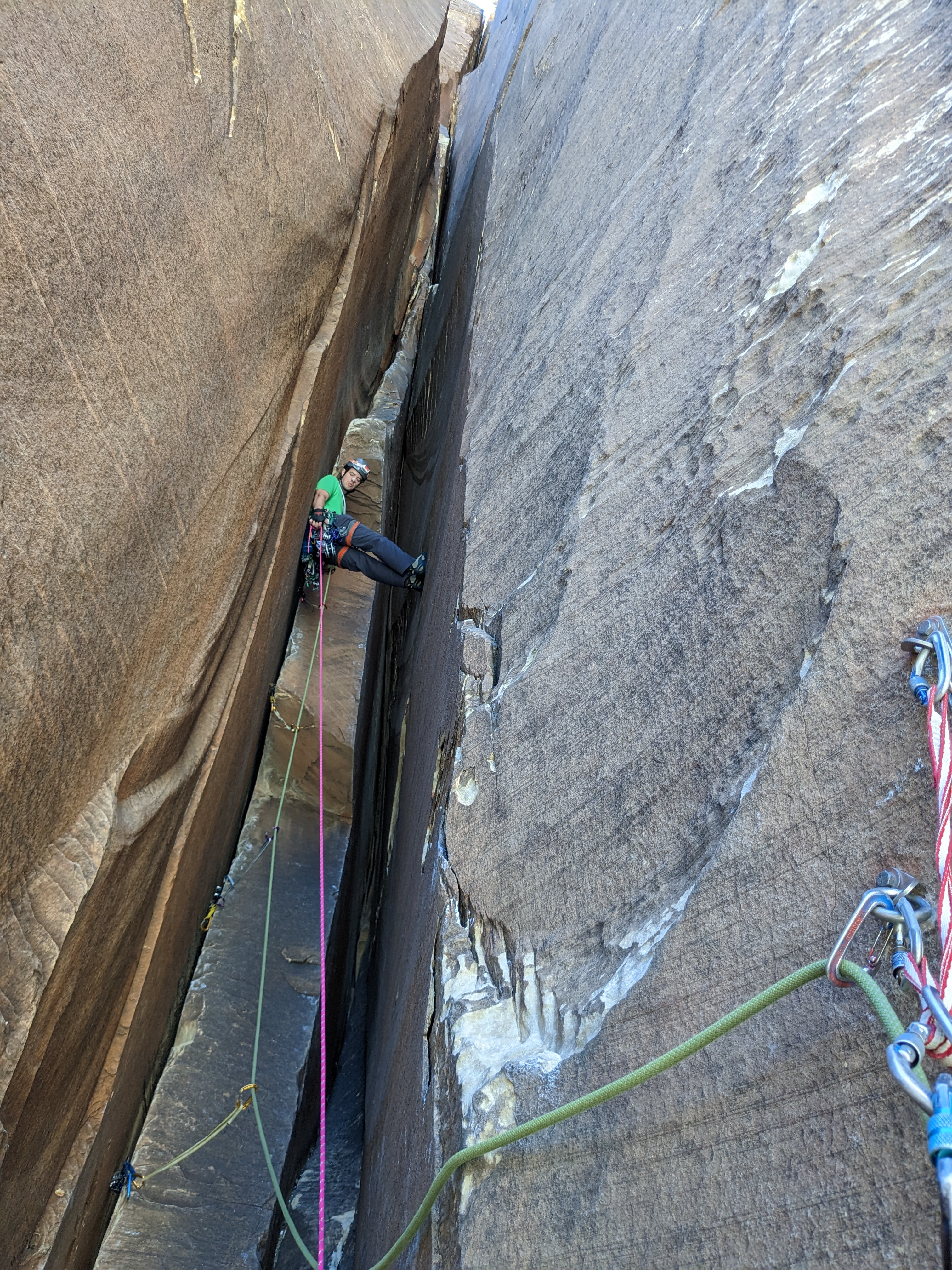 Me cruising Epi’s chimneys, (5.9, 16 pitches), Red Rock
See my Epi posts for more details and photos:
My first trad lead hang on gear, Inks Ranch, February 2024
During my first time at Inks Ranch here in Central Texas, I hung on my gear while leading Mister Poopy Crack (5.7, 1 pitch). It was my first time ever weighting my gear mid-lead on trad. I’ve done this a lot in sport climbing, but it took 10 years to get there in trad! For me anyways haha.
I’d choose to hang again during a trip to The Gunks in October 2024 on a piton above my gear. While most of the gear held, my piece below the piton zipped out because I didn’t put a long enough sling on it. Oops! Good to learn but not take the lead fall while learning!
My first trad lead while only crack jamming, Enchanted Rock, December 2024
B, Luke and I went to Enchanted Rock to climb cracks. I led Raw Meat (5.9, crack jammming) clean! I almost got Top Choice (5.10, crack jamming) clean too! And then we went on to do Texas Treescent (5.8) and Chimney Crack (5.6), I led both.
 Raw Meat (5.9+), Enchanted Rock
 Top Choice (5.10-), Enchanted Rock
Crack climbing is becoming easier for me.
My first trad lead fall on gear, Enchanted Rock, September 2025
I took my first lead trad fall on Becky’s Crack at Enchanted Rock, 11 years after starting climbing. I was climbing above my first piece and my foot slipped and I pinged off. My piece held, but I did knee the rock. I took some time to collect myself and then sent it without falling again. I’d re-lead it again in October 2025 and got from the top to the bottom without any falls or takes.
Reflections and recommendations
Its taken me years to get to this point in my climbing journey, with all of the experiences and lessons. So, I’d like to distill some reflections and recommendations on how I’m learning trad. Maybe they’re useful. Maybe they’re obvious. But, they’ll be some of what I relay to my friends that are learning more and more about climbing outside.
Find a mentor partner
A more knowledgeable partner willing to teach you is nearly priceless. This may be one person or multiple people; friends or guides. In my experience, having multiple mentors led to me learning differing safety systems :) which may have delayed my learning a system that I liked. But also it gave me multiple perspectives to think about.
Talk about concerns and mistakes
It’s crucial for safety to let your concerns be heard. As the learning climber, we should speak up when we feel scared or unsafe with a skill or situation. That way, the teaching climber can shift their approach, if needed. For example, if a learning climber doesn’t feel confident rigging their own rappel the first handful of times, the teaching climber can rappel second or setup a stacked rappel.
Start practice on the ground
Go over safety systems at the ground. Talk through them. Watch someone do it. Practice them yourself with your mentor giving you feedback. Practice them by yourself, get feedback again. Once that makes sense, try it from slightly off the ground to make sure you’re doing it right. Ideally we’re not learning the skill for the first time when we’re up high and the consequences are also high.
Practice safety system skills
You’ll need to learn a lot of different skills to lead trad safely. What follows is an possible progression of skills and experiences before you lead trad. Of course there are other progressions and ways. But this gives you some food for thought.
Here’s the progression I took:
- Top rope belaying, belaying a leader
- Sport lead with sport anchor clips - Practicing sport leading with ready made permanent anchors is a low stakes way to get experience reading rock, placing gear, not backclipping, etc – all of which will come into play leading trad.
- Top rope anchor and safe cleaning - While not strictly required for trad, knowing how to clean top rope anchors gives you a little practice with anchor craft in a safe situation and will unlock sport climbing outside. Austin’s Greenbelt and Reimer’s Ranch are unique sport climbing areas where folks are suggested to clip the lead rope directly into the sport clips / mussy hooks at the anchor. But most other places have a local ethic of building your own anchor on the top bolts for your rope - so get ready for those places like Inks Ranch and Enchanted Rock in Texas - both of which offer great trad routes and sport routes, with 2 bolt anchors.
- Multipitch sport & belaying your follower - If you have an opportunity to do some easy multipitch sport, you can work on your multipitch comfort - the height, the anchors, the rappelling, belaying a follower, etc.
- Follow trad - I had 6 super fun enjoyable trips to Red Rock before I even really tried jamming cracks, so you may be able to follow a trustworthy friend and definitely a guide up trad routes to see how you like the style of climbing, the exposure, the adventure.
In hindsight, I wish I had learned some skills sooner:
- Rappelling - Before doing multipitch, you should know how to rappel so you don’t have to learn during your first descent! You can practice this from the ground by walking back to tension the rope, or rappel a few feet down a tree with a crash pad below you.
- Trad gear placement & anchor building - I assumed it’d make sense and just led a route. As I said earlier, I’m glad I didn’t fall on any of my gear placements. Ideally you spend a lot of time at the ground placing gear, making a few different kinds of anchors, and maybe even build up to practicing trad gear placements on top rope/rappel like Dave MacLeod suggests in How I learned to place trad gear I’d trust with my life.
- Belay and rappel without a belay/rappel device - Honestly, I still don’t feel comfortable with this yet today. I recently learned the carabiner break for rappelling without a device. And I know how to tie a Munter hitch, but I haven’t actually used it to belay or rappel.
- Ascending ropes - I didn’t learn this until after having a near epic on Epinephrine with ropes getting stuck on rappel. But, I think it’s smart to learn this before you need to rappel since it can help you get to a rap station you went past.
- Jamming cracks - With the proper shoes, gloves, time, and determination, you may just learn to love crack climbing! While not required to follow or lead trad, it opens doors to more routes and enjoyment, in my opinion.
With those skills and experiences, you may be ready to lead trad! But. BUT. Listen to your mentor and yourself and if you want more practice or more experience, be safe.
Stay curious, evolve yourself and your systems
I enjoy sticking with a system that I know well enough to be safe and efficient. But, there’s likely way more to learn for adjacent tasks. While I may feel quick with building a trad anchor on multipitch, I’m less quick with awkward top rope anchors at Enchanted Rock or Joshua Tree. And, I have very little knowledge in self-rescue. So, there’s more to learn and practice now, and for a long time.
There’s no shortage of places to learn from. And this one blog post is insufficient :) I list just a few reflections here and many others have many more, for example Andy Kirkpatrick’s 1000+ Climbing Tips. Here are some more resources that I like:
- https://www.vdiffclimbing.com/
- https://www.alpinesavvy.com/
- https://www.andy-kirkpatrick.com/ and his books
- Book: Accidents in North American Climbing
- Book: Climbing Anchors, John Long & Bob Gaines
- Book: Self-Rescue, David Fasulo
- Video: Advanced Rappel Techniques
- Podcast: The Sharp End, Ashley Shaupe - Climbing stories can teach you a lot about what to do and not to do, and they can be way easier to learn from than information-dense technical manuals or narrow accident analyses.
- In-person instruction - I’ve taken a few climbing courses from local instructors, and always found them useful - not always new to me, but that’s because I also like learning by reading, listening, and watching in addition to in-person instruction.
Value safety thoroughness if you value your limbs and life
There’s an efficiency-thoroughness tradeoff in complex human systems, including learning climbing safely.
Efficient: There’s a part of all of us who which wants to learns skills quickly to get the dopamine that comes from success in our climbing objectives.
Thorough: You could spend days of full-time learning and practicing safety systems before even leaving the ground.
I wish my trad training had been more thorough even though that would have meant less efficient. I led trad prematurely. I followed multipitch without knowing how to rappel or ascend ropes. I built a trad anchor 3 pitches up before practicing on the ground. I’m grateful I got through these “efficient” lessons without injury.
So take time to learn from a mentor/guide and practice.
At some point, you’ll feel confident enough to put your knowledge to the ultimate test - leaving the ground and trusting your life to the safety system. You’ll believe your thoroughness is sufficiently safe, and you’ll want to GET TO IT and CLIMB already!
Be safe. Have fun.
What’s next for me in my climbing journey?
I have a lot I want to do and learn right now:
- More crack climbing. I want to lead the 5.9s clean in Enchanted Rock. I’ve gotten some but not all, so I have more to learn and practice.
- MORE MULTIPITCH TRAD! RED ROCK HERE I COME!
- Belay / rappel without a device
- Top rope trad anchors - I have spent a lot more time building multipitch anchors in Red Rock than building top rope anchors at Enchanted Rock and Inks Ranch and Joshua Tree. So I’m slower at making top rope trad anchors and want to get faster and more confident.
- Trusting trad placements - While I’ve led many trad routes now, I’ve only taken one real fall on my own gear - it held. I want to get more practice knowing the gear I placed will hold using the approach that Dave MacLeod suggests in How I learned to place trad gear I’d trust with my life. It’s similar to aiding, but it’s also top rope soloing.
- Bolt maintenance - I haven’t done this yet but I’d like to help with re-bolting around Austin. And that’ll require a lot of learning.
- Top rope solo (TRS) / lead rope solo (LRS) - I saw someone top rope solo aiding with a stick clip to setup a top rope. I thought this was super neat! Being able to do this means I could setup a top rope for me and my son! So, I bought Andy Kirkpatrick’s top rope solo book called On The Line and I’m reading it and I’ll probably need to buy his lead rope solo book too. There are entirely different systems for top rope soloing and lead rope soloing that are distinct from the normal climber/belayer safety system.
Lots to learn!